
 BACK TO OUR BLOG
Verifying Site Conditions Before Retrofits and New Flushmate Installs
Many of the toughest Flushmate-related service calls trace back not to manufacturing defects, but to small installation and commissioning mistakes made months or years earlier. A supply valve left partially closed, a misaligned actuator, a tank-to-bowl gasket that never quite seated correctly—each can turn a well-designed pressure-assist system into a chronic nuisance for maintenance teams and restroom users alike. For facilities that are actively standardizing on Flushmate-equipped fixtures in high-use restrooms, paying close attention to how those systems are installed and started up is one of the fastest ways to improve performance and reduce callbacks.
The first step is to treat Flushmate installations as a system, not a drop-in swap. Before any retrofit or capital project, you should:

 Verify building water pressure at the restroom or branch serving the new fixtures. Flushmate systems for the 503 and 504 series are designed to operate within a defined pressure window, and installing them in locations with marginal pressure can result in sluggish filling, reduced performance, or inconsistent behavior. (Hint: For the 503 the ideal range is 20-80 psi, for the 504 it's 25-80 psi.) OEM maintenance and troubleshooting guides, such as the pressure-assisted toilet maintenance guide linked at Sloan Pressure-Assisted Toilets Maintenance, emphasize checking line pressure and supply valves as a first diagnostic step; those same checks should be baked into your pre-installation planning.

 Determine whether you’re working with a one-piece or two-piece toilet.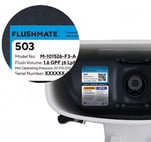
Use OEM compatibility charts and tools like the part finder at Flushmate Part Finder to confirm that the replacement vessel matches the china and actuation type you’re installing. Of course, you can always text us a picture of your serial number, and we can look it up for you.

 Check your physical clearances around your toilet tank. Physical clearances around the tank also matter. Unlike a simple gravity fill valve swap, adding or replacing a Flushmate vessel requires enough room to maneuver the tank, access the vessel, and service key components over time. In tight chases or ADA layouts, verify that lids can be removed and that technicians can access the cartridge, air inducer, and supply connections without dismantling partitions or grab bars. The most important question about physical space is "is this a 10 inch rough in or a 12 inch rough in?" To get this measurement, measure from the finished wall to the center of the floor bolts or flange, not the baseboard. If that measurement is about 10”, you need a 10” model; if it is about 12”, you need a 12” model.
Finding Step-By-Step Guidance For Retrofits, Rough-Ins, and Commissioning
Once rough-in conditions are confirmed, focus turns to the actual installation steps and the mistakes that tend to show up months later as nuisance service calls. One of the most common is misadjusted actuators or trip levers. If the handle linkage is too tight, the actuator can hold the cartridge off its seat just enough to cause run-on conditions; if it is too loose, users experience weak flushes or intermittent activation. There is a simple solution to this issue, you can remove the linkage altogether and replace it with the new cable actuated handle (503 Model, 504 Model). OEM instructions for compatible automatic and manual actuation kits—such as the various installation and troubleshooting guides at the Flushmate Resources page —include detailed steps and diagrams for setting actuator height, alignment, and sensor range. Translating that information into your own “good, better, best” photos and diagrams for internal training helps technicians recognize correct versus incorrect setups at a glance.
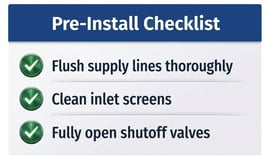 Another frequent pain point is incomplete flushing or noisy refill caused by debris in the inlet screen. During renovations, it’s common for sediment to move through supply lines; if installers don’t flush the line and clean the screen before final connections, that debris can restrict the vessel’s fill rate and compromise performance. Make it standard practice to flush supply lines thoroughly, inspect and clean inlet screens, and verify that shutoff valves are fully open before calling the installation complete. Reinforce this practice by building it into your commissioning checklist and pre-occupancy inspections, so project teams are held accountable for leaving fixtures truly ready for use, not just “installed.”
Creating Checklists, Training, and Partnerships To Keep Installs Consistent
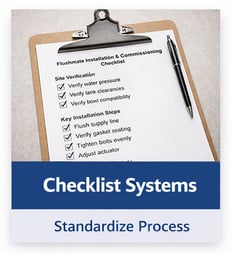 To prevent recurring installation mistakes across projects and campuses, treat Flushmate setup and commissioning as a documented, repeatable process. Start by creating a simple, one-page checklist that covers site verification (pressure, clearance, bowl compatibility), key installation steps (flush line, verify gasket seating, tighten bolts evenly, adjust actuator), and commissioning tests (cycle count, fill time, leak inspection, noise standard). Attach this checklist to your capital project templates and require contractors to complete and submit it as part of closeout, ideally with photos of representative installations.
Next, fold Flushmate training into your broader restroom and water conservation curriculum. Hands-on sessions where installers and maintenance staff can practice assembling tanks, adjusting actuators, and diagnosing deliberately “misinstalled” units are far more effective than slide decks alone. Use the official OEM resources at Flushmate Installation Resources as the technical backbone, but frame them in the context of your own buildings and standards.
 Finally, work closely with a specialty distributor who can help review plans and submittals for upcoming projects and spot potential issues—such as incompatible bowls or questionable rough-in assumptions—before they become field problems. A partner focused on institutional plumbing, like The Part Works, can also assist with stocking appropriate repair kits and replacement vessels, ensuring that if an installation issue slips through, your team can correct it quickly without waiting for long lead times. Over time, that combination of clear documentation, active training, and responsive parts support will turn Flushmate installations from a source of surprises into a well-understood strength across your facilities portfolio.

Text us a picture of your Flushmate,
including the serial number, to identify your model.
